Subscribe to receive the latest blog posts to your inbox every week.
Thank you! Your submission has been received!
Oops! Something went wrong while submitting the form.
At the heart of the United States power supply stack sits natural gas. It fuels most of the new generation, supports grid reliability, and increasingly underpins the power consumed by data centers, manufacturing, and electrification. Yet the physical behavior of shale gas production tells a more fragile story than most markets appreciate.
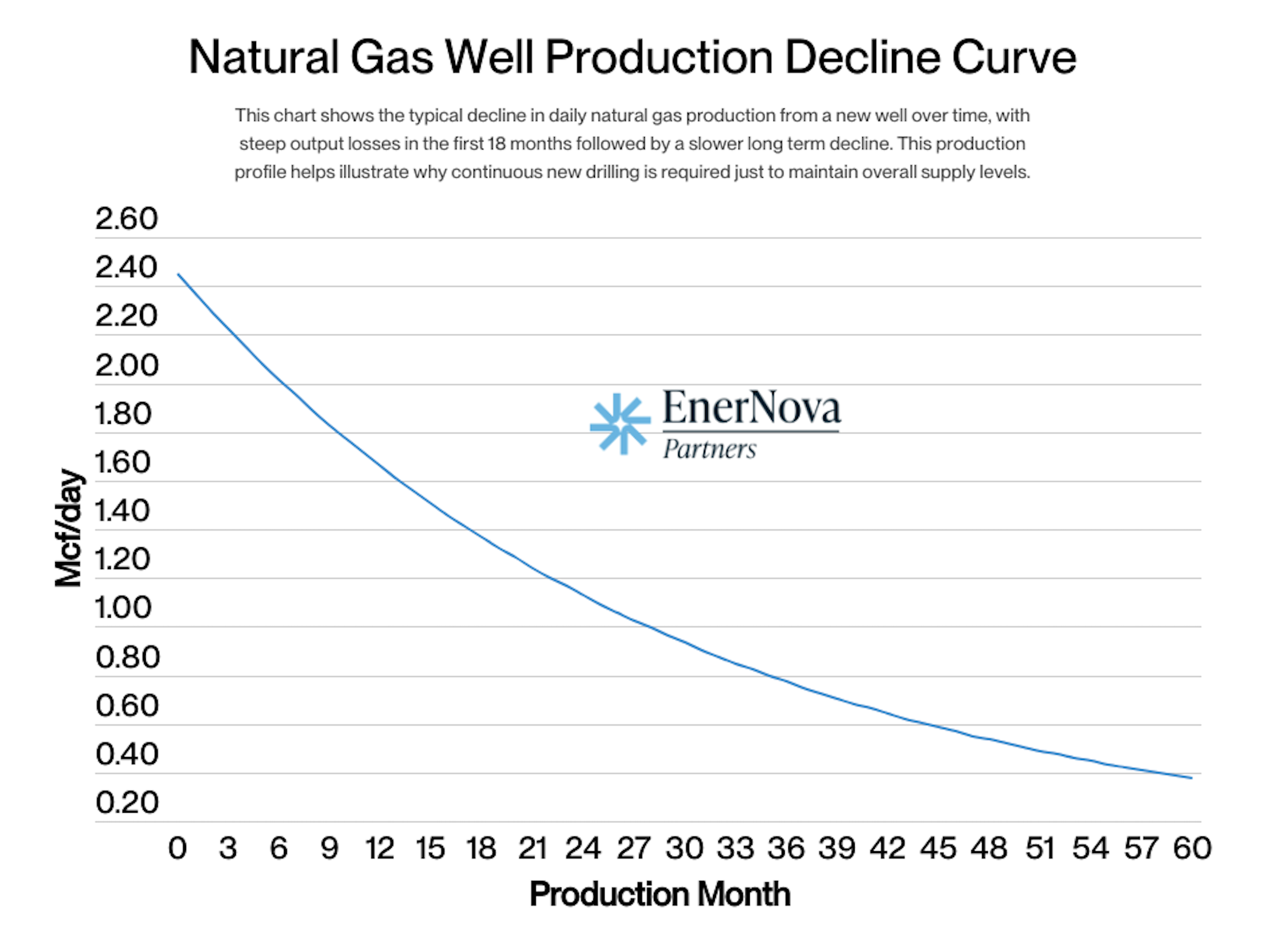
The chart above illustrates a representative natural gas well production decline curve. Production begins at a high initial rate but declines rapidly in the early years. Most of a shale well’s total lifetime production is delivered within the first 30 months. After that point, output falls into a long gradual tail that can continue for many years but at sharply reduced volumes.
This behavior is driven by the physical nature of shale formations. Natural gas is trapped at high pressure within dense rock. When the formation is fractured, gas flows rapidly at first as pressure is released. Over time, that pressure dissipates and production slows. Even though wells may remain active for many years, the economic impact is driven by early life output.
This creates a structural reality for the gas market. To maintain flat production at the basin or national level, new wells must constantly be drilled to offset declines from existing wells. Supply does not sustain itself naturally. It must be continuously replenished with capital.
The evolution toward horizontal drilling has amplified this dynamic. Horizontal wells deliver significantly higher initial output than traditional vertical wells but also experience steeper decline rates. While drilling efficiency has improved dramatically and raised early production, it has not removed the need for rising well counts to meet new demand.
This reality matters deeply for power markets. Natural gas remains the marginal fuel for electricity pricing across most of the United States. As load from artificial intelligence, data centers, electrification, and reshoring accelerates, the grid will lean even more heavily on gas fired generation for reliability.
From a market perspective, this creates long term upward pressure on fuel supply costs whenever drilling slows or capital becomes constrained. It also reinforces why electricity prices remain structurally linked to natural gas even as renewable penetration increases.
At EnerNova, this decline curve is just one of many physical and market fundamentals we evaluate when helping clients manage long term energy risk. In today’s market where prices are trending higher, the question is not how much you can save but how much you can avoid overpaying. Our role is to ensure clients buy smart, secure the most competitive structures available, and protect long term supply and pricing strategy across changing market conditions.
Subscribe to newsletter
Subscribe to receive the latest blog posts to your inbox every week.
Thank you! Your submission has been received!
Oops! Something went wrong while submitting the form.
.png)



.svg)